
On a summer day in August, shortly after pulling her kayak up on the shore of Bde Maka Ska, a lake in south Minneapolis, a local woman paused by a new metal sign, asking her to rate the lake from zero to 10.
“I’d give it, probably an eight,” she mused, after noticing, next to the 10 rating, a graphic portraying a glass of drinking water. “I’m not a drinker of lake water under any circumstances, so eight’s as good as you’re going to get.”
Her rating was a fresh piece of data for researchers at the College of Biological Sciences (CBS) and beyond, who typically look at more objective measurements. Chlorophyll concentrations signal algal blooms; a Secchi disk, lowered until the point of disappearance, quantifies water clarity; phosphorus and nitrogen measurements reveal nutrient pollution. All these data are used to inform widespread efforts, especially in the Twin Cities, to improve water quality. And there is some evidence that these efforts are working. This year, 57 lakes within the seven-county metro are proposed to be delisted from the Minnesota Pollution Control Agency’s impaired waters list.
With hundreds of millions of dollars spent on water quality improvement every year in the state, kayakers, swimmers, fishing enthusiasts, and lakeside dog-walkers should all notice a difference. But do they? How do scientists and policymakers know if the public really notices? Regardless of efforts to improve the quality of those waters, is it possible that public opinion on the quality of urban lakes is stagnant or declining? A collaborative team of researchers from the University of Minnesota and the University of Saint Thomas (UST) designed a survey experience to answer those questions and identify possible gaps in water quality education amongst lake users. Bonnie Keeler, director of the Water Resources Center, Jacques Finlay, professor of Ecology, Evolution and Behavior and Moos Freshwater Faculty Fellow, and UST professor Chip Small lead the research team as they weave survey findings into a broader ecosystem of continuous water monitoring, environmental education and local policy. The project grew from the multi-disciplinary Minneapolis-St. Paul Metropolitan Area Long Term Ecological Research Program (MSP LTER).
At 17 sites across the metro, metal signs invite anyone to text a number to rate the water quality on a scale from zero to 10. Helpful graphics signal a “zero” rating as hazardous, while the “10” is marked with a water glass, challenging participants to imagine lake water so clean they could drink it. The scale was developed by the Environmental Protection Agency (EPA) to examine the full range of possible water quality for economic studies. Easy to access through a simple text message, the researchers designed the survey to cast a wide net, including those who might cross the street to avoid a traditional clipboard-toting survey administrator. Once a participant sends their numerical rating, an automatic text response hooks them into answering more specific questions about what motivated their water quality rating and their experience with the lake that day.
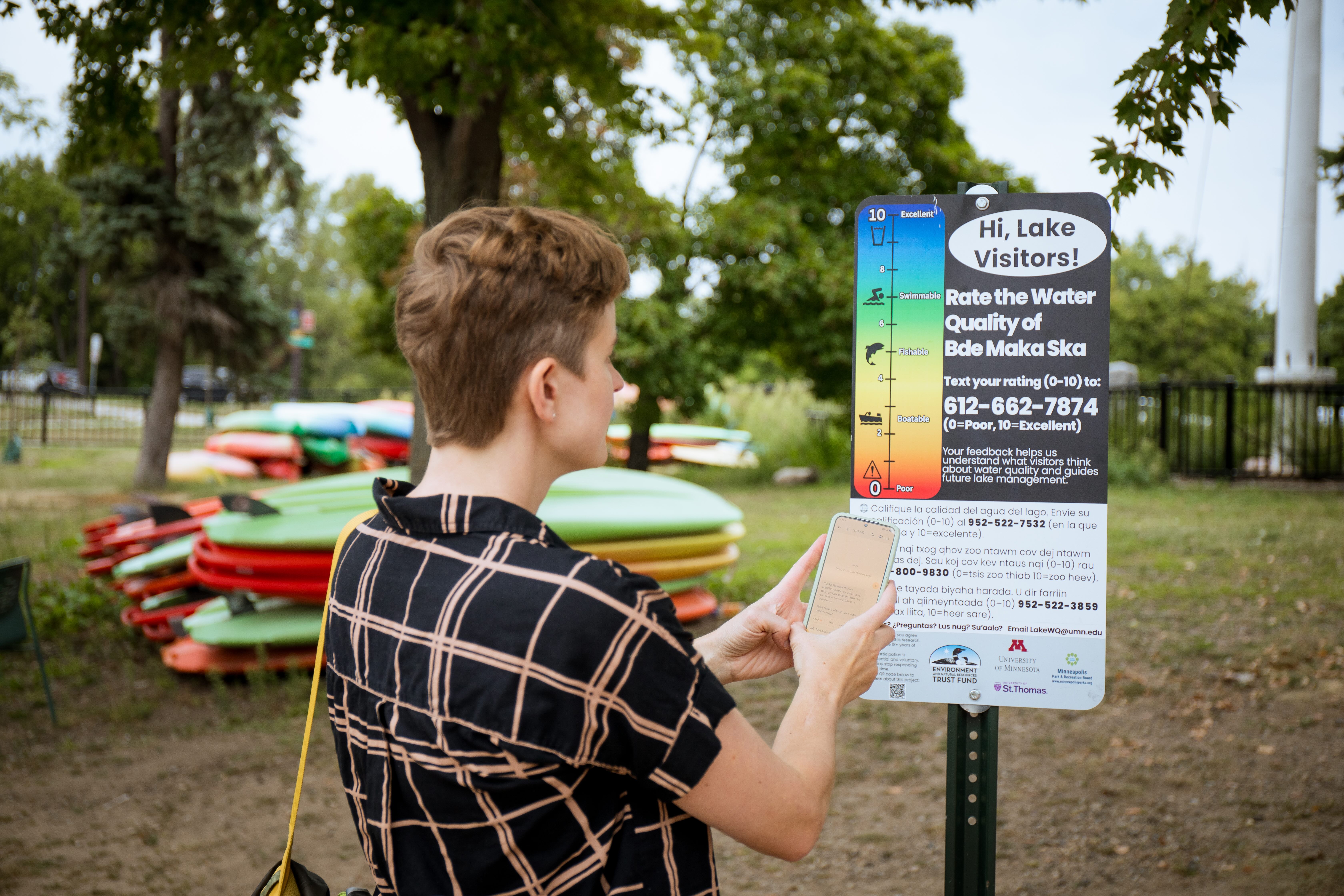
Some responses are actionable, like one respondent who requested additional benches along the lakeside to increase accessibility. Other responses capture the mood of the day. “Forced to take a walk with my family,” one respondent vented.
Regardless of one’s attitude at the time of taking the survey, MSP LTER researcher Becky Forgrave argues, “The more you build people’s connection to the lakes…that leads to more advocates for a lake, which can lead to more funding for water quality improvements, more support at the state level for major water quality actions.”
The project received funding from a number of sources with a shared interest in water quality, including Minnesota’s Environment and Natural Resources Trust Fund, administered by the Legislative-Citizen Commission on Minnesota Resources.
All of those survey responses — the weird, the specific, and the zero-to-10 number ratings — are data that local watershed districts and the Minnesota Department of Natural Resources can use to analyze the public perception of their water quality improvement efforts. Understanding how the public feels, regardless of the chlorophyll count, will not only direct resources for environmental education, it will give experts a chance to evaluate how well they are communicating water quality improvement to the people splashing around in Minnesota’s lakes.
“This project is entirely built on partnerships, from data collection by agency partners, the integration of biophysical and social science methodology, and work with partners to develop and implement the study and to interpret data,” Finlay reflected.
The data the partnership analyzes will depend on widespread public participation. Through the end of October, look out for metal signs near lakes in the metro, and add your own perception of lake water quality to the record. –Hugh Gabriel