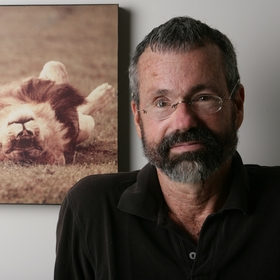
Craig Packer
Distinguished McKnight University Professor; Director, The Lion Center
Ecology, Evolution, and Behavior
Craig Packer received his undergraduate degree from Stanford University in 1972. He then went to the University of Sussex to complete his Ph.D. research on olive baboons in Tanzania. After a brief study of macaques in Japan, Packer returned to Tanzania in 1978 to head the Serengeti lion project. He joined the faculty of the University of Minnesota in 1983, returning to Africa for several months each year. Packer received a J.S. Guggenheim Fellowship in 1990, became a Distinguished McKnight University Professor in 1997, and was elected to the American Academy of Arts and Sciences in 2003 and the American Association for the Advancement of Science in 2019. He is the author of three books: Into Africa (1994), Lions in the Balance (2015), and The Lion: Behavior, ecology and conservation of an iconic species (2023), as well as over 200 scientific articles. Since 2015, he has collaborated with scientists and conservationists in Kenya, Namibia, South Africa, and Tanzania on carnivore conservation and grassland restoration.
Learn more
Learn more
Research statement
Over a quarter of Africa's people rely on livestock for their livelihoods. But burgeoning human populations have put unsustainable pressures on the biodiversity and productivity of grasslands and savanna habitats in Kenya and Tanzania,. As scientific director of the Mara Predator Conservation Program, I work with colleagues from the Kenya Wildlife Trust, Smithsonian Institution, and various conservation organizations to find ways to promote human-wildlife co-existence while simultaneously reducing overgrazing by pastoralist livestock in the Greater Mara Ecosystem of southern Kenya. At the same time, I work closely with colleagues from the US, Canada, UK and Germany to find the optimal mix of native plant species that can be reseeded in overgrazed pastures of northern Tanzania while at the same time collaborating with local Maasai communities to develop sustainable livestock grazing strategies in newly restored pastures.